We Both Added Claude. Now What?
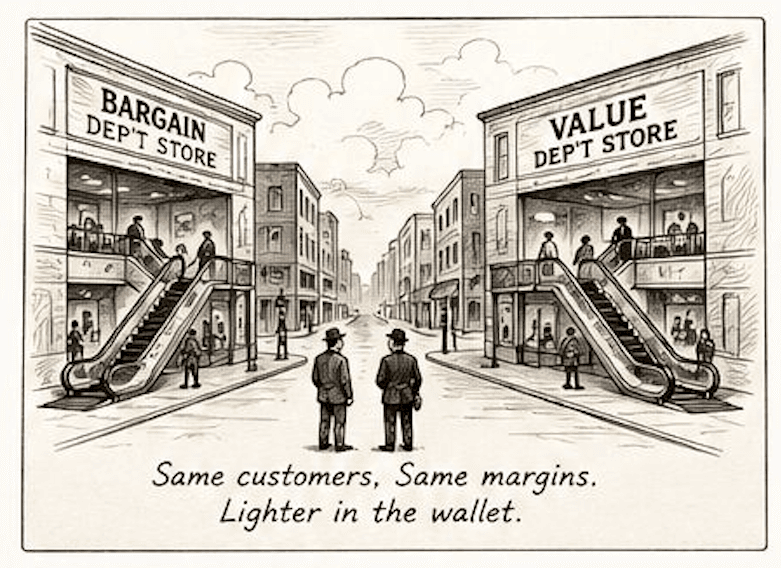
Warren Buffett's department-store escalator, applied to the every-app-now-has-a-copilot stampede. Escalators vs. staircases, and which kind of spending actually wins.
Warren Buffett owned a department store in the late 1960s. When the store across the street put in an escalator, he put one in too. Both spent the money. Neither got anything for it. Same margins, same customers, same two stores staring at each other across the street, just lighter in the wallet. The escalator wasn't an edge. It was a toll for staying in the game.
I think about that story a lot lately, mostly because I spend my mornings patting an AI on the head before my coffee's even gone cold. Some days it ships something I'm proud of. Some days it invents an API that has never existed and I have to gently walk it back to reality. Either way, we keep working. But there's a version of this whole moment, the trillions, the every-app-now-has-a-copilot stampede, that smells exactly like two department stores buying the same escalator.
The escalator is here, and it's called a copilot
Look at what's actually shipping. Every serious software company has bolted on an "assistant," an "AI tier," or an "advanced analytics" upsell in the last eighteen months. Notion, Salesforce, HubSpot, Atlassian, Microsoft, Adobe. It's not a trend, it's a roll call. And here's the tell: most of these features are wrappers around the same handful of foundation models that the competitor down the street is also calling. When my differentiator is "we added Claude" and yours is "we added Claude," we have both just installed the escalator.
The market is already sniffing this out. Buyers in 2026 are actively discounting feature-based moats, paying instead for data depth, workflow lock-in, and proprietary datasets that create durable differentiation. Put more bluntly by the same people: bolted-on AI with no data moat and no NRR impact gets you nothing. That's the escalator dynamic in valuation language. A feature anyone can rebuild by next quarter isn't a moat. It's table stakes you paid full price for.¹

Where the analogy actually breaks, and why that's the good part
Here's the thing I have to be honest about, because dunking on the whole industry would be cheap and also wrong. The escalator is a fixed thing. You install it once, and forever after it does the exact same job for you and your rival. But some AI spending isn't like that at all. Some of it compounds.
“A company whose AI gets materially better every quarter because it is learning from a growing proprietary dataset is worth more than a company with static AI features built on the same foundation models every competitor has access to.”
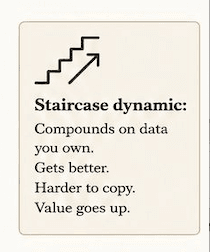
That's the escape hatch. A system fed by data your competitors can't touch doesn't equalize over time, it pulls ahead. And the numbers back it: even after accounting for the margin hit, one 2026 benchmark found that growth from AI-native companies outweighed the hit on margins, in short, it pays to be an AI-native company.²
So the worry isn't "AI is a waste." It's narrower and more useful than that. Buying capabilities everyone else can also buy is an escalator. Building something that compounds on data only you have is a staircase that keeps growing under you. The trillions are unsettling because so much of the money is going into the first while being pitched as the second.
The question I now ask every feature
Before I get excited about the shiny new AI thing, mine or anyone's, I try to ask the Buffett question out loud:
“When this is done, will I have a margin I can defend, a cost I've actually lowered, or a spot my competitors can't reach? Or will we just both be standing on the same floor, escalators humming, having spent the money to end up exactly where we started?”
Most of it, I suspect, will be escalators. The ones who win this won't be whoever installed AI fastest. They'll be whoever built the thing the escalator couldn't copy.
And the rest of us? We show up, give the machine a pat, and get back to work, eyes open about which kind of spending we're actually doing.
Liked this? Pat the dog and subscribe.
One article every Tuesday. Nothing else.